Xinjiang Unveiled: The Chinese Settler
In the third part of this guest written series on Xinjiang, we hear from Han Chinese settlers — lured by opportunity and captivated by exoticism, yet navigating a vastly different culture.
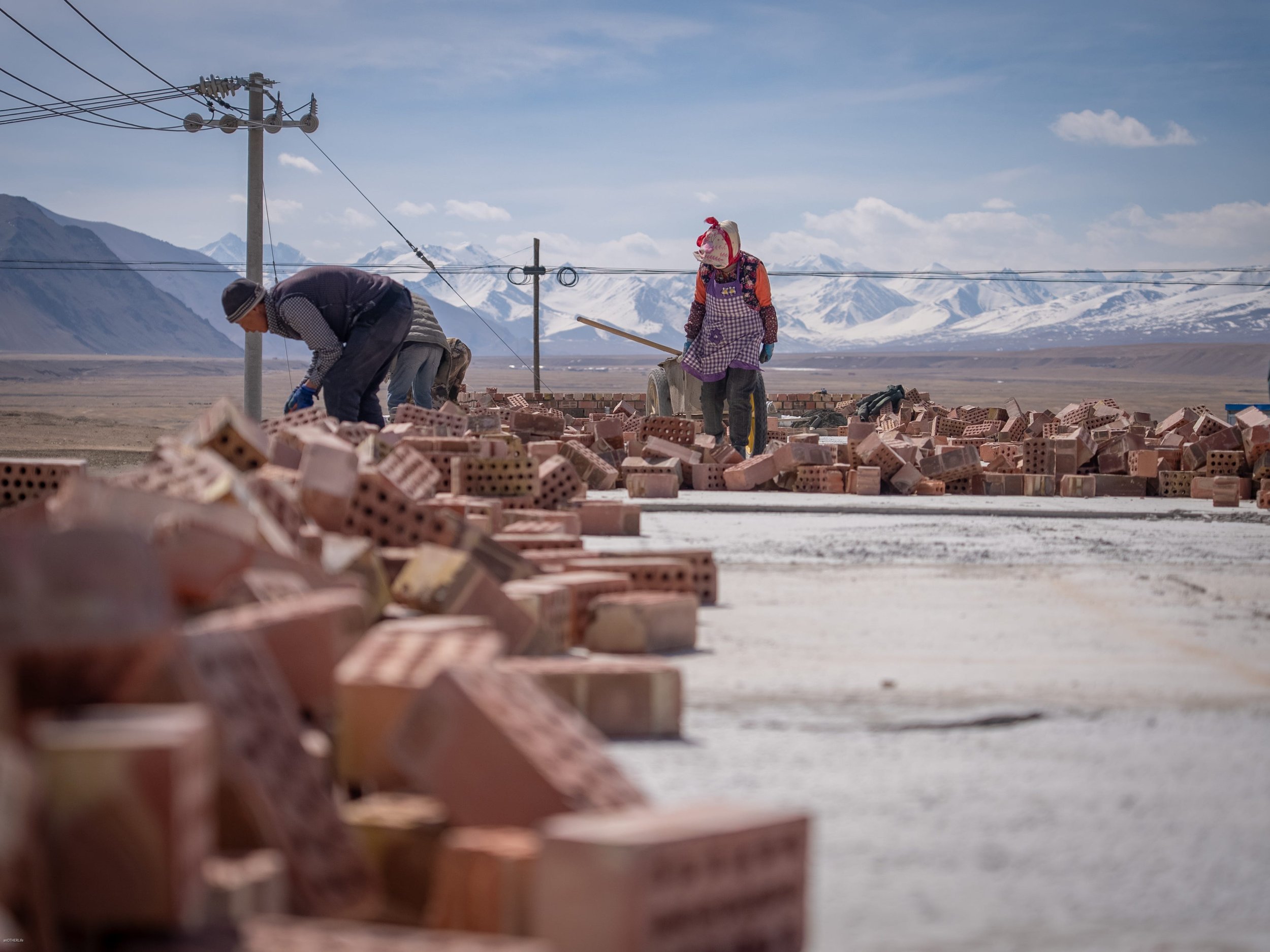
Chinese workers labour on a new building in the rugged borderlands of Western Xinjiang — a remote frontier where progress is carved out, brick by brick.
I somehow convince L to take an 18-hour overnight train to Kashgar. There’s no first class, no express option — I pitch it as the “authentic experience”. We board a slow sleeper train, crammed into a six-person compartment: three bunks stacked high on each side. The persons at the bottom-most “bunk” must endure the occasional whiff of feet as the passengers above climb up and down. To avoid this, we claim the topmost bunks — trading foot traffic for a night spent just inches from the train’s cold metal roof. To this day, I’m still not entirely sure why L sticks around.
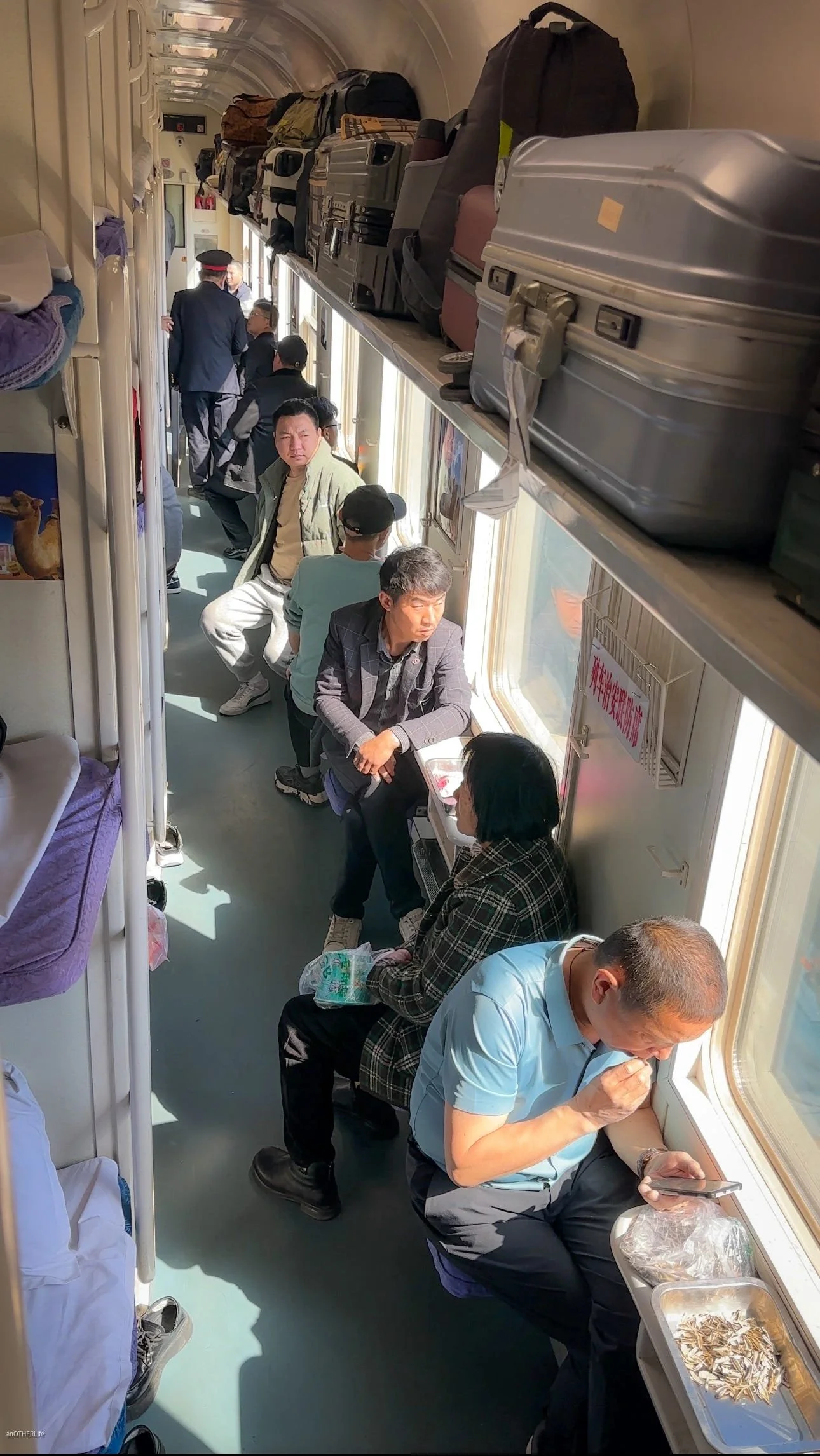
Our train to Kashgar: looked like a relic, but rode like a charm. Clean sheets, kind strangers — zero roaches scurrying along the aisles. A win in our books!
We arrive groggy at 4 a.m., stumbling out of the station into pitch-black streets. This time, we come prepared — a room at an “international hostel” booked in advance. We call a Didi (China’s Uber equivalent) and, to our relief, reach our destination without a hitch.
The hostel feels like a well-kept secret — a fraction of what Urumqi charges, yet spacious, spotless, and wrapped in the quiet charm of Uyghur textiles and curios. We collapse into bed, exhausted but quietly excited for whatever Kashgar has in store.
The Jewel of the Silk Road
For over two millennia, Kashgar stood as a vital crossroads on the ancient Silk Road — a place where cultures met, caravans converged, and exotic goods from across continents exchanged hands. Ancient poets once praised it as the “City of Saints,” evoking visions of Sufi mysticism and Islamic scholarship. But not all depictions were romantic: others spoke of a city afflicted by erasure and loss — where the Uyghur collective memory was slowly eroded by successive waves of Chinese state control.
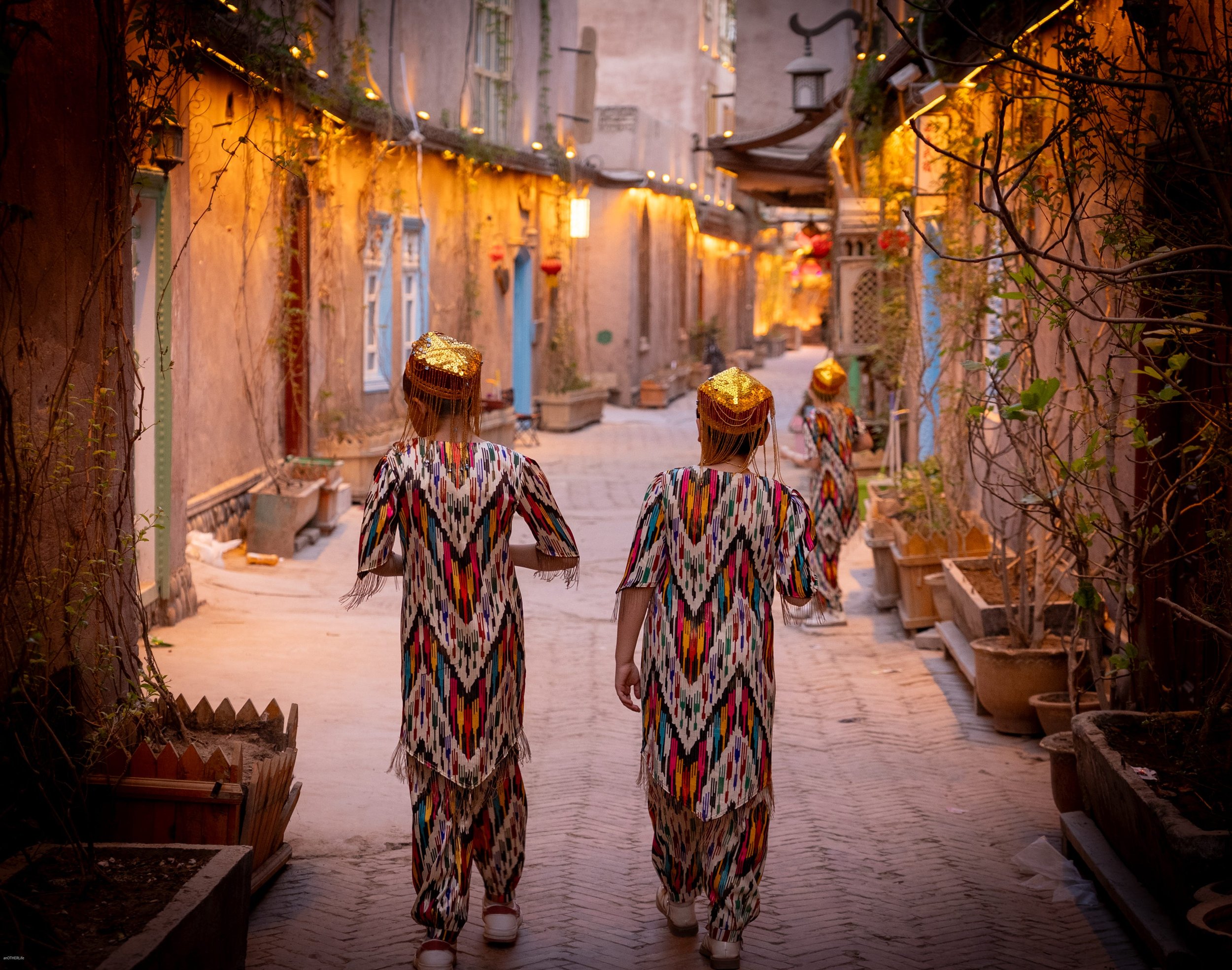
Children in vibrant Uyghur costumes wander the Old Town.
We visit the famous Kashgar Old Town — a sprawling maze of narrow alleyways and restored mud-brick houses, celebrated for its traditional Uyghur architecture. While some Uyghur families still live here, the area feels more like a Disney-fied sprawl than a living, breathing community. We see tourists parade through in rented ethnic costumes, snapping selfies in front of ancient doorways. Flocks of security cameras perch on poles where pigeons once roosted, and courtyards once teeming with family life now house hipster boutiques selling the scented snake oil of an “authentic” Uyghur past. Kashgar’s Old Town, which might once have felt like stepping into a breathing scroll of Central Asian history, now feels hollow — a polished trinket of its former soul.
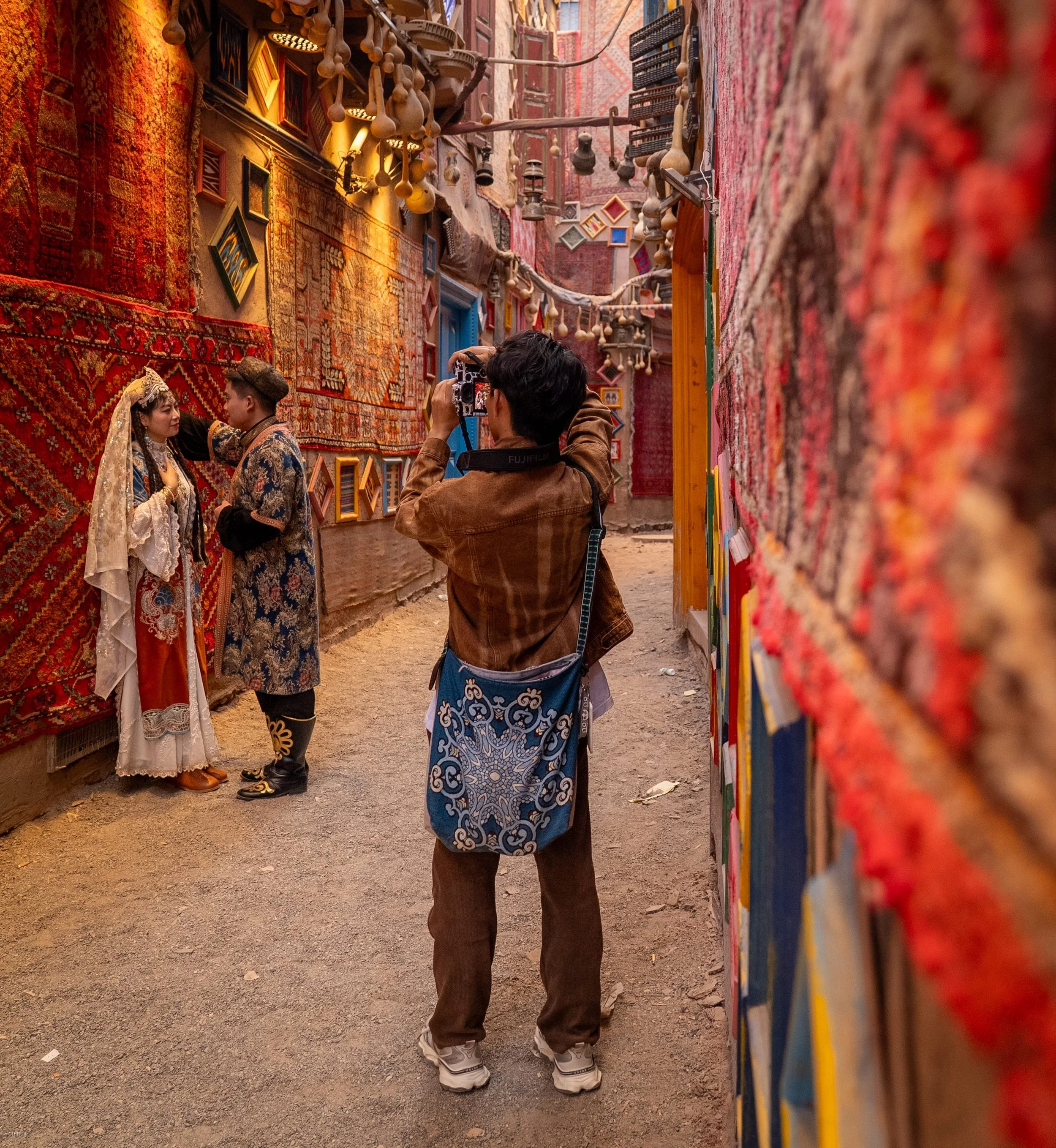
In Kashgar’s Old Town, a Chinese couple poses for portraits dressed as a Uyghur prince and princess — an act of tourism wrapped in silk and staged nostalgia.
Back at our hostel, we walk into a scene of confusion. A middle-aged Australian couple is checking in, and the husband — who introduces himself as a social media influencer — is frustrated that the Chinese staff don’t speak English. He rattles off a list of demands, and since he doesn’t speak Mandarin, I offer to help translate. Soon, I too am sucked into his whirlwind of requests and find myself helping him install a VPN so he can upload his travel videos to YouTube — one of many foreign platforms blocked in China. But when the VPN fails, he grows irritated, clearly expecting me to fix everything. I manage to extract myself with help from L, and we avoid him from that point on.
Fleeing the hostel, we meet a kind, heavyset Uyghur man who invites us to sit outside his shop for tea and nuts. He speaks little Mandarin, but we get by with Google Translate and body language honed over years of travel. We leave with full hearts — and what feels like the beginning of a warm friendship.
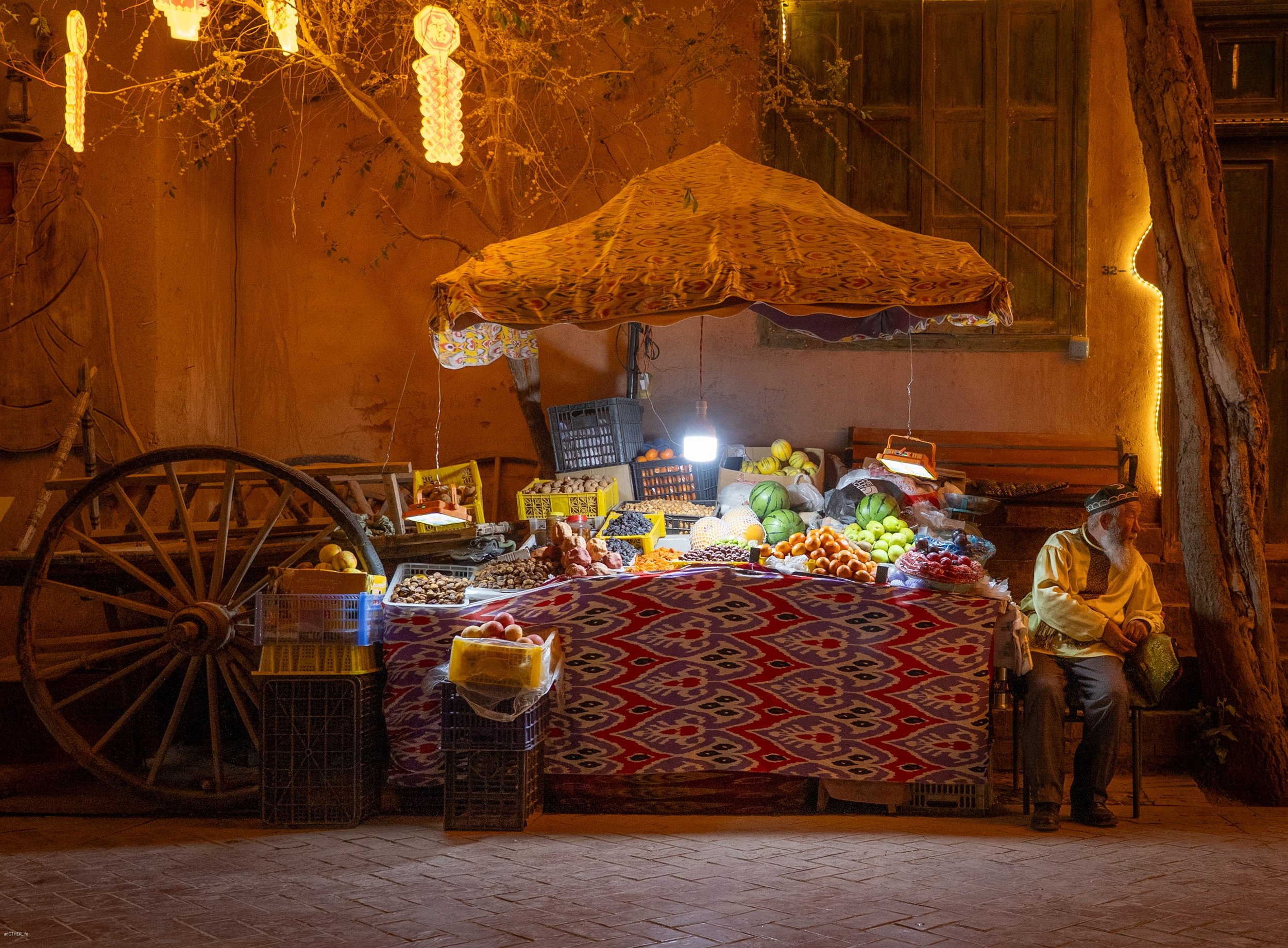
Fruit vendors line the streets in Kashgar, their stalls overflowing with a mix of colours and flavours — roasted nuts, dried berries, and delicacies like Turpan grapes, Xinjiang figs, and fresh mulberries.
A few days later, we return to him with a gift of fruits and nuts. But this time, his demeanour changes entirely. He declines the offering and abruptly excuses himself. When we try again the next day, he waves us away and vanishes into his shop. The rejection stings. In many cultures we’ve experienced, refusing a gift isn’t just unusual — it signals distance or even disrespect. What had we done wrong to offend him?
After that troubling encounter, a strange series of events begins to unfold.
The Uyghur children who used to gather in the hostel lobby — laughing, curious, playful — suddenly stop coming. When we see them in the neighborhood, they avert their eyes and walk away as if some invisible line had been drawn. Were the stories we’d heard from other travellers — of Uyghurs being cold and unfriendly to foreigners — true after all?
The next day, word trickles down the hostel grapevine: the Australian YouTuber had been caught filming at the neighbourhood elementary school. When teachers confronted him and told him to stop, he kept recording. Worse, he’d reportedly wandered into several Uyghur houses uninvited, camera rolling, treating their homes like an exotic backdrop for his vlogs.
That same evening, a new face appears in the hostel — a sharp-eyed man with a hardened edge who clearly isn’t a wide-eyed traveller. He hangs around the common areas, trying to join conversations and even asking to play the guitar with me. Something feels off. I quietly approach the front desk. One of the staff leans in and whispers: he’s undercover police, sent to watch and report on foreign guests. She warns us to be careful — thanks to the YouTuber’s antics, we are now under close surveillance.
And just like that, the illusion is gone. The surface charm of exotic Kashgar cracks.
The veil is lifted.
The Ever-seeing Eye
In the days that follow, we drift through Kashgar like silent dancers engaged in a wordless ballet of cat and mouse with the shadow state. We aren’t here to provoke or stir tensions — only to learn and listen, to shield those we meet from suspicion by association. But under the constant gaze of the state, even truth learns to hold its breath.
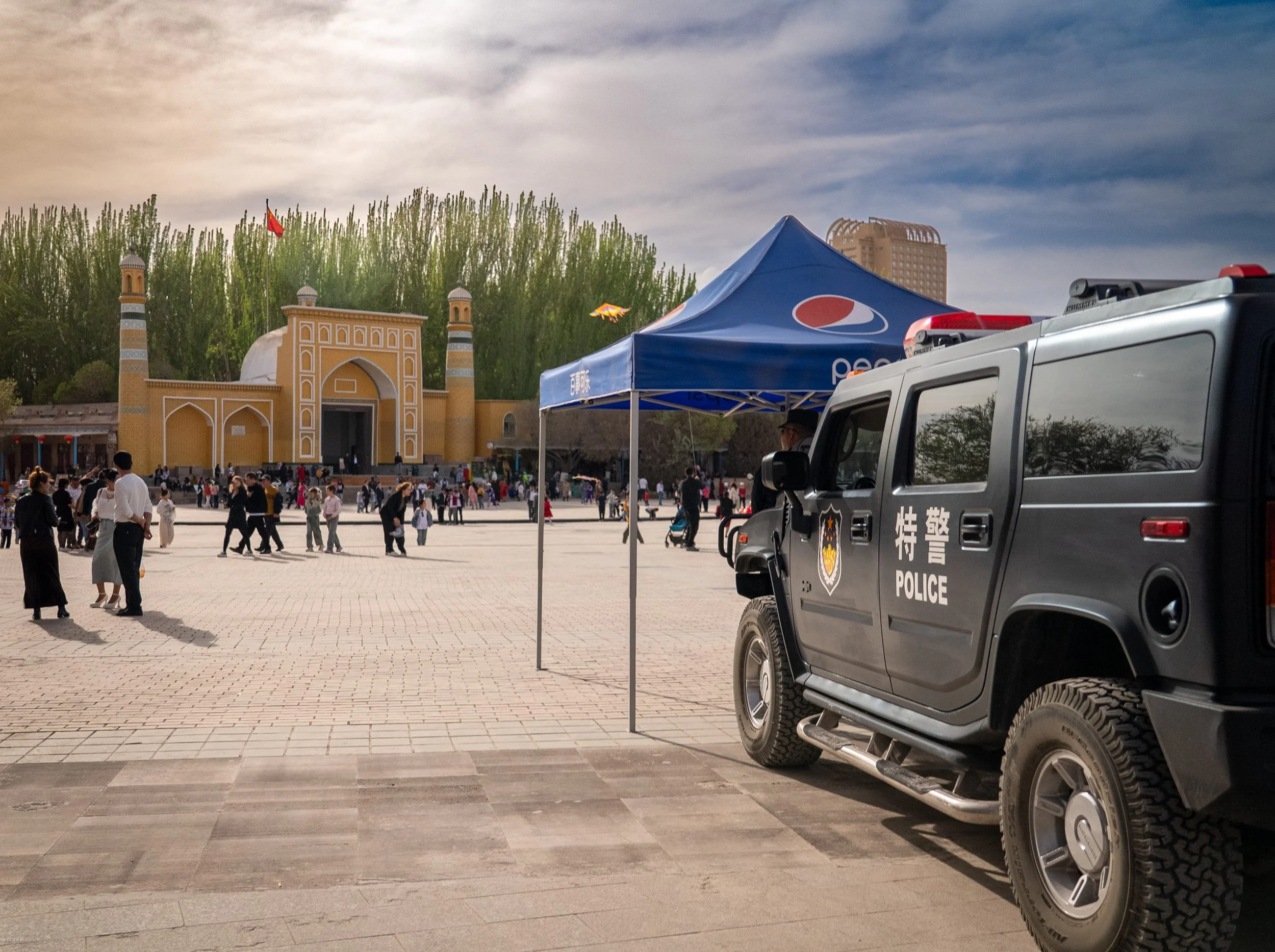
Armed police patrols are a frequent sight outside mosques and religious sites throughout Kashgar — a quiet but constant reminder that faith and surveillance often stand side by side.
One morning, just as we step outside, an elderly Uyghur woman gestures for us to follow. She smiles and motions toward her home, inviting us in for tea. After two cautious weeks in Xinjiang, it’s the first time we’re offered a glimpse inside a real Uyghur home. We want to say yes, but worry our presence might put her at risk, especially with the presence of the undercover police. We thank her and gently explain, in broken phrases, that we’re tourists. But she insists — unwavering, warm — and we follow her inside.
Her home is modest: two stories, dimly lit, with a small shared courtyard. The dining room is sparsely furnished, and she lays out a tray of fruits and pours us tea. There’s a heaviness in her smile — a weariness we can’t quite name, and her words elude us. We sit together in partial silence, sharing smiles and gestures, doing our best to connect across the divide.
After a short while, I excuse myself to fetch some snacks to bring back. But as I step outside, I’m intercepted by Zhang, our hostel’s owner — a young Han Chinese man who’d come to Xinjiang chasing entrepreneurial dreams. He waves me over, his expression tense.
“Don’t go back in,” he says under his breath. “It’s dangerous.”
Eating Pork = Freedom
Zhang gestures for me to sit, and lowers his voice even more.
“The police have ordered us not to host any more foreign guests,” he says. “They're on high alert.” I offer my sympathy — this must be a blow to his business. But he rapidly brushes off my concern, and what follows becomes the most revealing conversation of my time in Xinjiang.
(To keep his perspectives as clear and unfiltered as possible, I’ve decided to share this “transcript” of our chat from the notes I scribbled right after our conversation.)
Zhang: You cannot go into Uyghur peoples’ houses, it’s not safe.
Me: But why? She invited me in.
Zhang: Yes, but the police are watching. They are worried that foreigners will twist the truth and report bad things about the situation here. You’ve heard of the re-education camps and “black jails” for the Uyghurs right?
Me: Yes.
Zhang: The re-education camps are real, I can even tell you where they are. I know people who have been taken there. A foreigner who lived near here wrote about them some time back and the police locked down our neighbourhood.
Me: But if the camps are real, as you say, then wasn’t the foreigner simply stating facts?
Zhang: You don’t understand. The government may have made some mistakes in Xinjiang, but on the whole they are doing a good job. People’s lives have greatly improved and this is no longer a dangerous place. Even Uyghurs are now freer — they don’t have to follow Islam so strictly anymore.
Me: What do you mean?
Zhang: Well, now they can drink alcohol and eat pork if they choose to. Isn’t that a good thing for them?
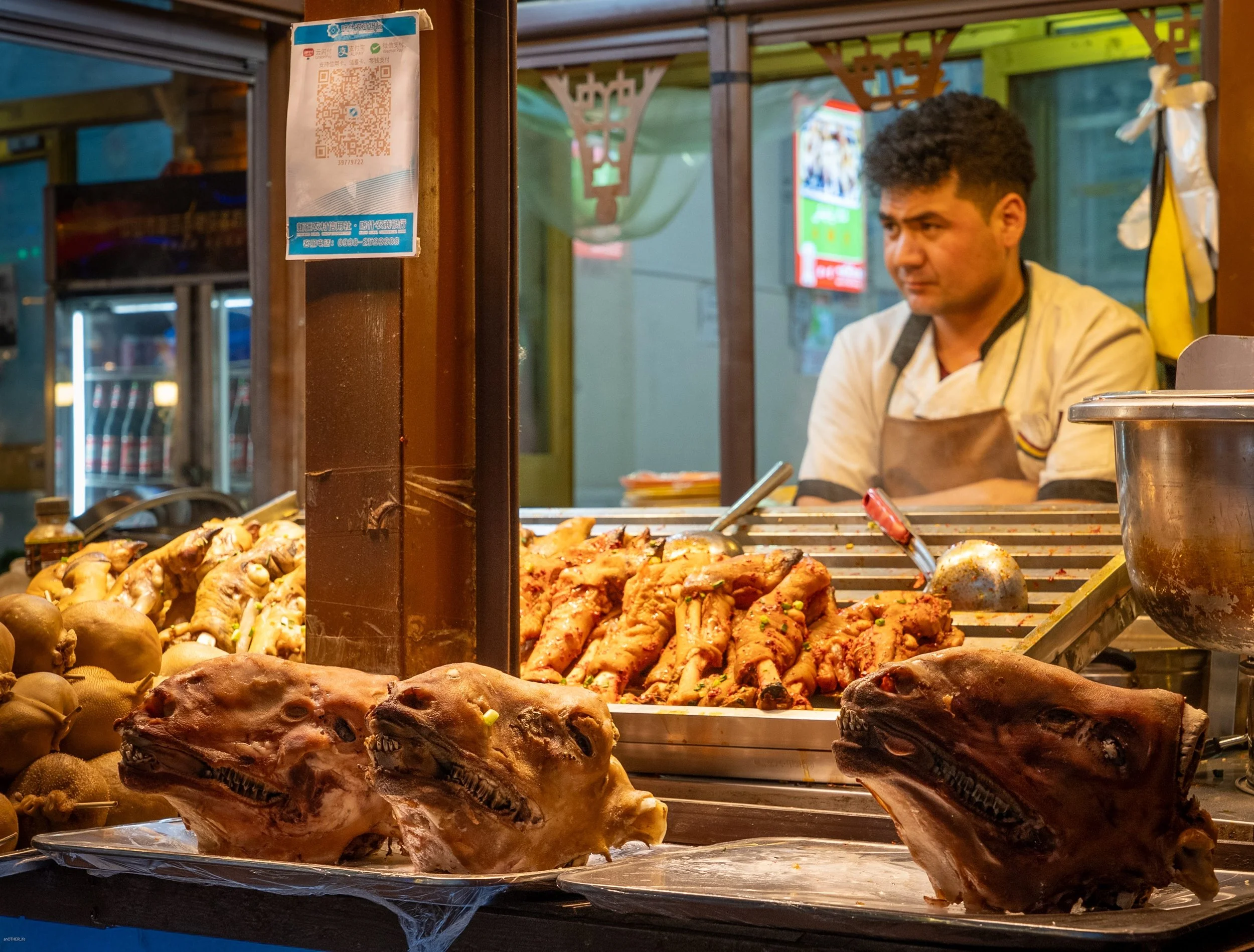
A Uyghur vendor waits patiently beside his steaming spread of stewed sheep’s head, feet, and offal. In Xinjiang, most animals are fair game, with one exception: pork, which is strictly avoided by Muslim Uyghurs.
At this point, I try hard to mask my shock. He equated freedom for Muslim Uyghurs with the right to eat pork — something strictly forbidden in their faith. What stood out even more than his claim was the tone in which it was delivered — with the calm assurance of a fait accompli, as if religious identity were a dietary menu preference that’s easily revised. I couldn’t help but wonder — in being “freed” from their God, had the Uyghurs simply been assigned another?
I fight my urge to challenge him. I don’t want to pass judgment or interrupt, so I let him continue.
Zhang: Foreigners think that Uyghurs are so unfortunate. But many of them simply don’t work hard to succeed. They don’t save money and just spend it on decorating their homes. There is a programme to pair Han Chinese households with Uyghur households. If the Uyghur household does not produce enough crops, the Han family makes up for their shortfall. Uyghurs always say it’s more important to be happy, but how can you be happy if you don’t keep striving to be better and progress in life?
Me: Maybe it’s just a different world view — different values?
Zhang nods, admits this is just his personal view, but then shifts the conversation.
Zhang: You know, I once was a backpacker like you when I was younger, and I disagreed with many things our government was doing. But I travelled to many countries like Pakistan and Iran and met many people who told me they envied China for its economic progress. My views have changed. Our government is doing a good job here, it’s just that as ordinary citizens, we can’t see the big picture. We must trust our government because the results are real. Just look at our country now. That’s proof.
Me: Do most Uyghurs here feel the same way as you?
Zhang: Maybe not, but that’s because they haven’t fully embraced their Chinese identity. Our government is working to change that. Now when a Uyghur marries a Han Chinese, the couple is given a monetary reward. Also, schools no longer teach the Uyghur language, children learn Mandarin instead. Maybe in 20 to 30 years when they begin to feel more Chinese, they’ll be allowed to learn Uyghur again.
Me: Isn’t that in a way taking away their past, their culture from them?
Zhang: To be honest, that is nothing. I know much worse things that happen in the Uyghur re-education camps that even Western media doesn’t know about. But some bad things are necessary for good to happen. Anyway, foreigners have a very superficial understanding of the local situation, they only write about the bad things and omit the good.
Me: But isn’t this a conundrum? I’m trying to meet Uyghur locals so I won’t have a superficial understanding, but even you — a hostel owner, a private citizen — tells me not to speak to locals. So how can foreigners understand the situation better if they aren’t even given a chance to see the larger picture?
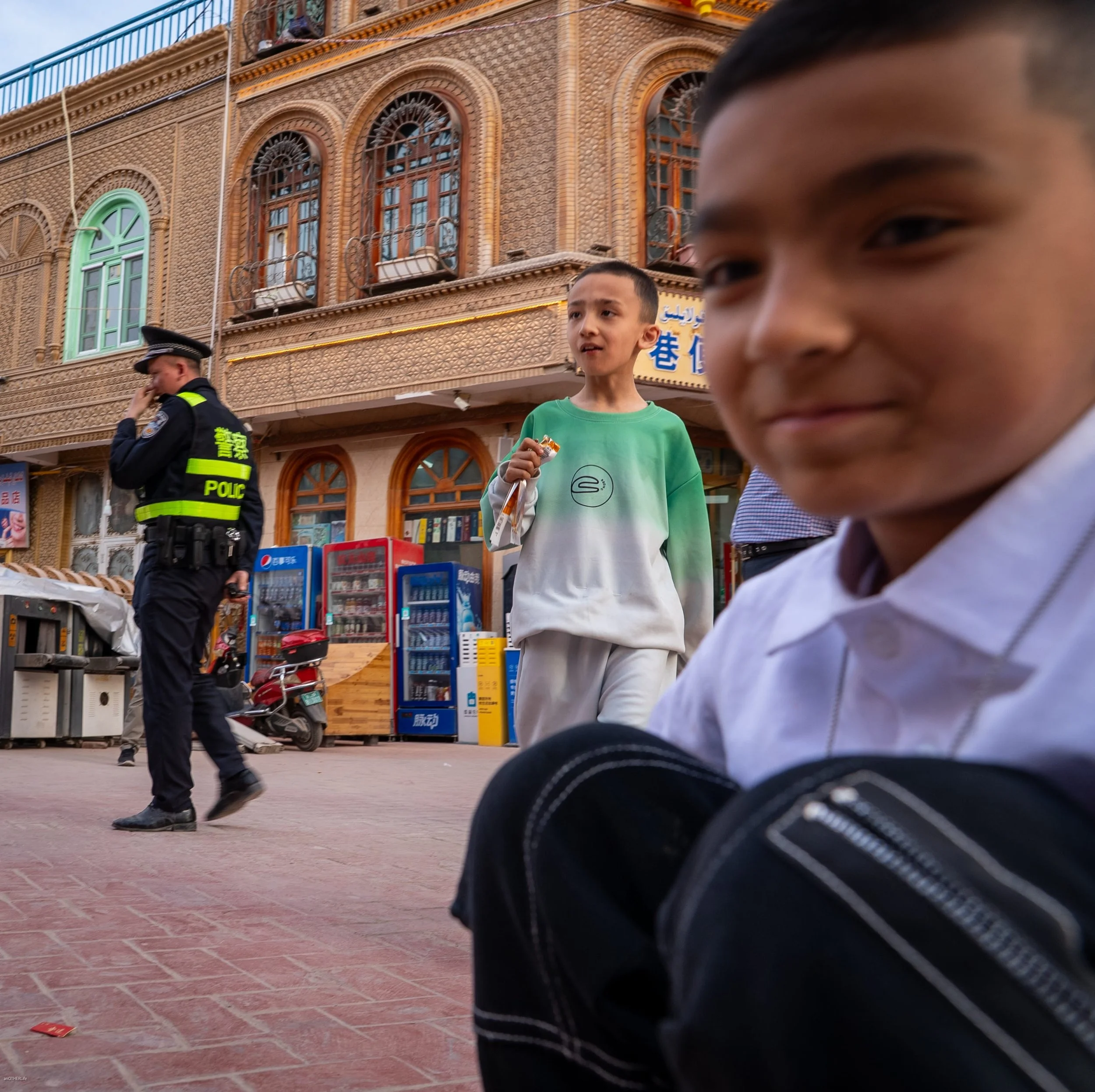
Uyghur boys play children's games in a public area beneath the watch of a police officer.
Soon his business partner joins us and both men become fully invested in schooling a novice foreigner on the realities of Xinjiang. The conversation splinters into different directions but the themes are similar:
1. The Chinese government has “liberated” Xinjiang — economically, socially, even spiritually.
2. Re-education camps, while regrettable, are necessary to achieve the greater good of peace and prosperity.
3. Foreigners don’t see the big picture and are unconsciously trying to stymie China’s progress. What China is doing to protect itself — restricting free speech, foreign media or personal freedoms — is essential for its progress.
What strikes me most in the conversation is their fierce conviction. The young men weren’t just parroting the Party line in the name of pragmatism — it was pure belief, firm and internalised. Their travels abroad, far from broadening their views, seemed only to have deepened their faith in China’s one true path. In their eyes, the results spoke for themselves: prosperity, order, national strength. If some things had to be sacrificed to achieve that, so be it. Everything else could wait.
My hour-long re-education session ends. I’m emotionally drained, my thoughts scattered.
I’m grateful for their candour. Their openness offers a rare glimpse into a layered Han Chinese perspective — shaped by historical memory, national pride, and an unshakeable belief in progress. Parts of it are pragmatic. Others are far harder to morally reconcile.
The unsettling conversation only deepens my desire to hear the Uyghur side of the story, but even after two weeks in Xinjiang — despite every effort — the Uyghur voice remains elusive.
That is about to change.
This is the third of a 4-part series guest written by my partner S on our experience in China’s Far West, 15 years after riots first broke out in Urumqi. The final part explores Xinjiang through the eyes of Uyghurs.
Part 1: The Foreigner, The Chinese, The Uyghur
Part 2: The Foreign Tourist
Part 4: The Uyghur Native
