In the final part of this guest written series, we focus on the Uyghurs — whose quiet, everyday struggles reveal a deeper, often unspoken reality that simmers and seethes beneath the surface.
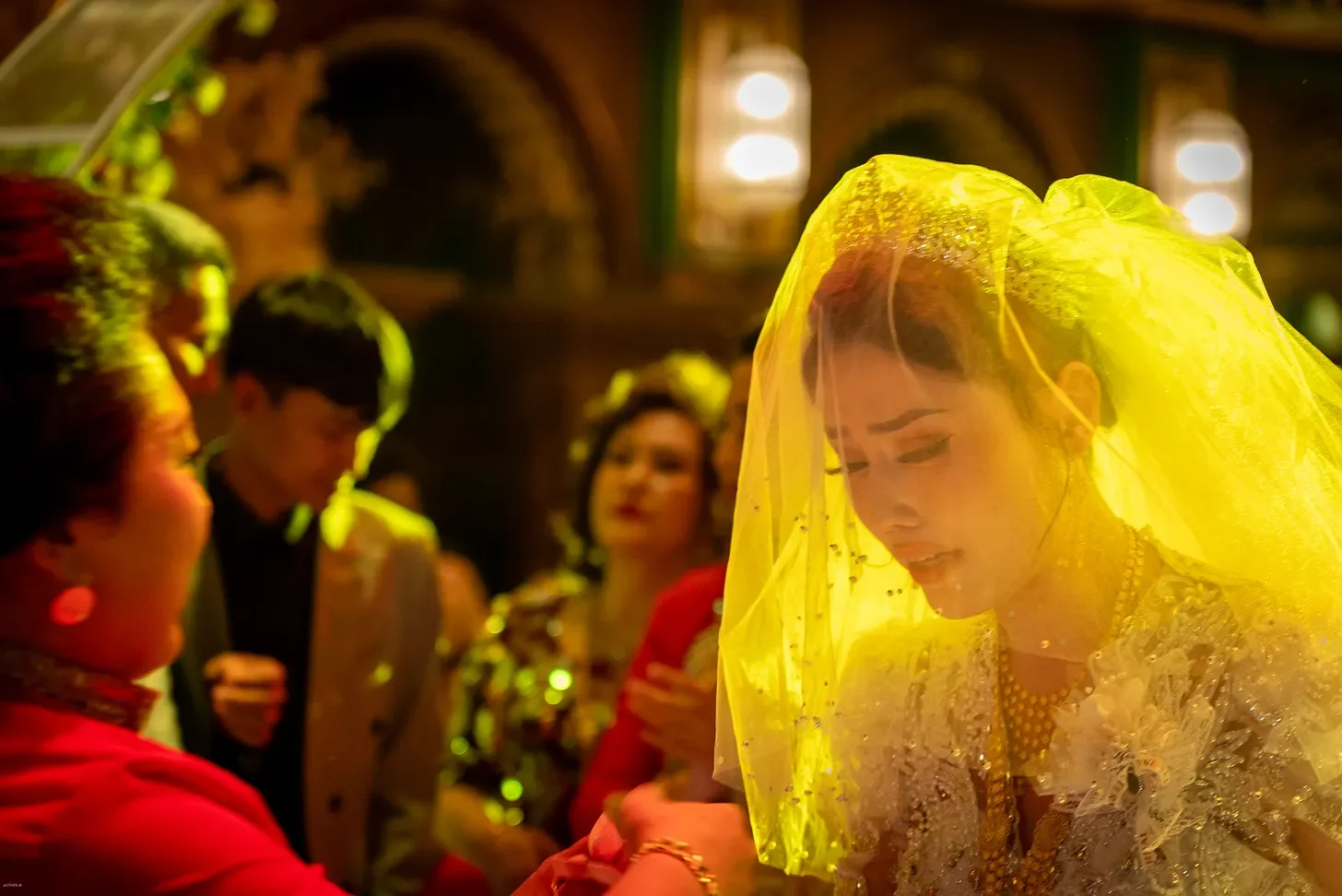
A Uyghur bride falters with emotion as a relative blesses her with gifts at her wedding.
The undercover police are now a permanent fixture in the hostel, even staying overnight. Word filters through that the Australian YouTuber is being tailed around the clock by a rotating cast of plainclothes “escorts.” One of the hostel owners, perhaps as a veiled warning, lets slip that even the taxi drivers ferrying him through town are officers in disguise. No move goes unmonitored.
Naturally, we grow more cautious too. One day, we cross paths with a group of Uyghur schoolchildren, who innocently share a disturbing revelation: their neighbourhood leaders have issued a notice instructing locals to avoid foreigners and refrain from allowing photos. Anything, they’ve been told, could be twisted and used for “nefarious purposes”.
Suddenly, it all clicks.
The shift in atmosphere — the hostility from the Uyghur shopkeeper, the silence from the children — wasn’t a product of suspicion or cultural divide. It was fear — a fear planted by those in power. Through cloaked warnings and coded language, the authorities had fanned a quiet xenophobia amongst the Uyghur residents — one that made even a friendly wave or an offhand chat with a foreigner feel like a dangerous gamble.
This is how paranoia trickles down. This is how trust disappears. And it’s the people — never the Party — who end up paying the price.
The Pigeon Man
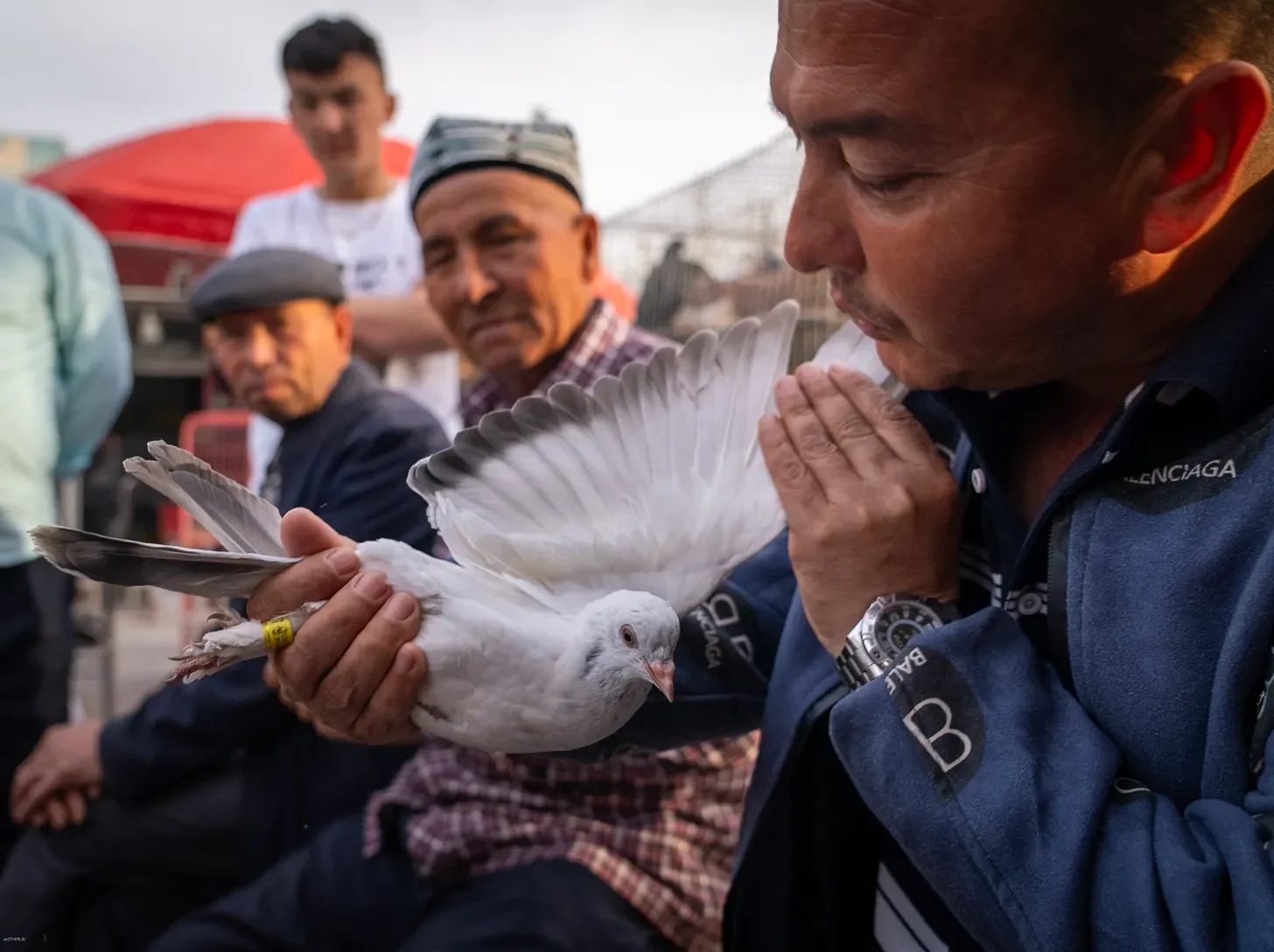
A Uyghur man proudly shows off his racing pigeon to us at Kashgar’s pigeon market, where birds are judged on pedigree, wing strength, and flight form.
It’s been nearly three weeks in Xinjiang, and frustration has begun to set in. Despite our best efforts, we haven’t had a single meaningful conversation with a Uyghur beyond small talk and polite nods. The presence of undercover police still looms large — always nearby, always watching — and with our departure nearing, we decide that maybe it’s better to stop pressing.
We learn that some Uyghurs still quietly practise the centuries-old tradition of pigeon racing. It seems innocuous enough, so we decide to settle instead for a chance to witness something rooted in culture and untouched by politics.
Or at least less touched.
At dawn and dusk, when the city lies quiet, Uyghur “pigeon men” climb to their rooftops. From afar, we often see their dark silhouettes cut against the pale sky as they wave long sticks in graceful arcs, guiding flocks of pigeons swirling tightly above. The birds don’t just fly — they dance. Arcing, diving, turning together in a silent, hypnotic display. This centuries-old tradition unfolds as a mesmerising blend of art, movement, and quiet meditation — and that is what we are hoping to witness up close.
One afternoon, at a local eatery, we meet a bright-eyed Uyghur woman in her early twenties. She’s warm, articulate, and curious about us. We strike up a conversation. When we casually ask where we can watch pigeon racing, she pauses thoughtfully, then her face lights up.
“My uncle keeps many,” Aylin shares excitedly. “I can take you!”
She glances over her shoulder as she says it — just briefly — and we know to keep things quiet. We exchange numbers discreetly.
The next day, we meet Aylin and her younger sister, Rana, in a quiet alley. They lead us down a narrow path, as if they’re guiding us somewhere secret. The house they take us to is small, nestled quietly out of sight, tucked away from the bustling streets. We are careful and check that no one is following us.
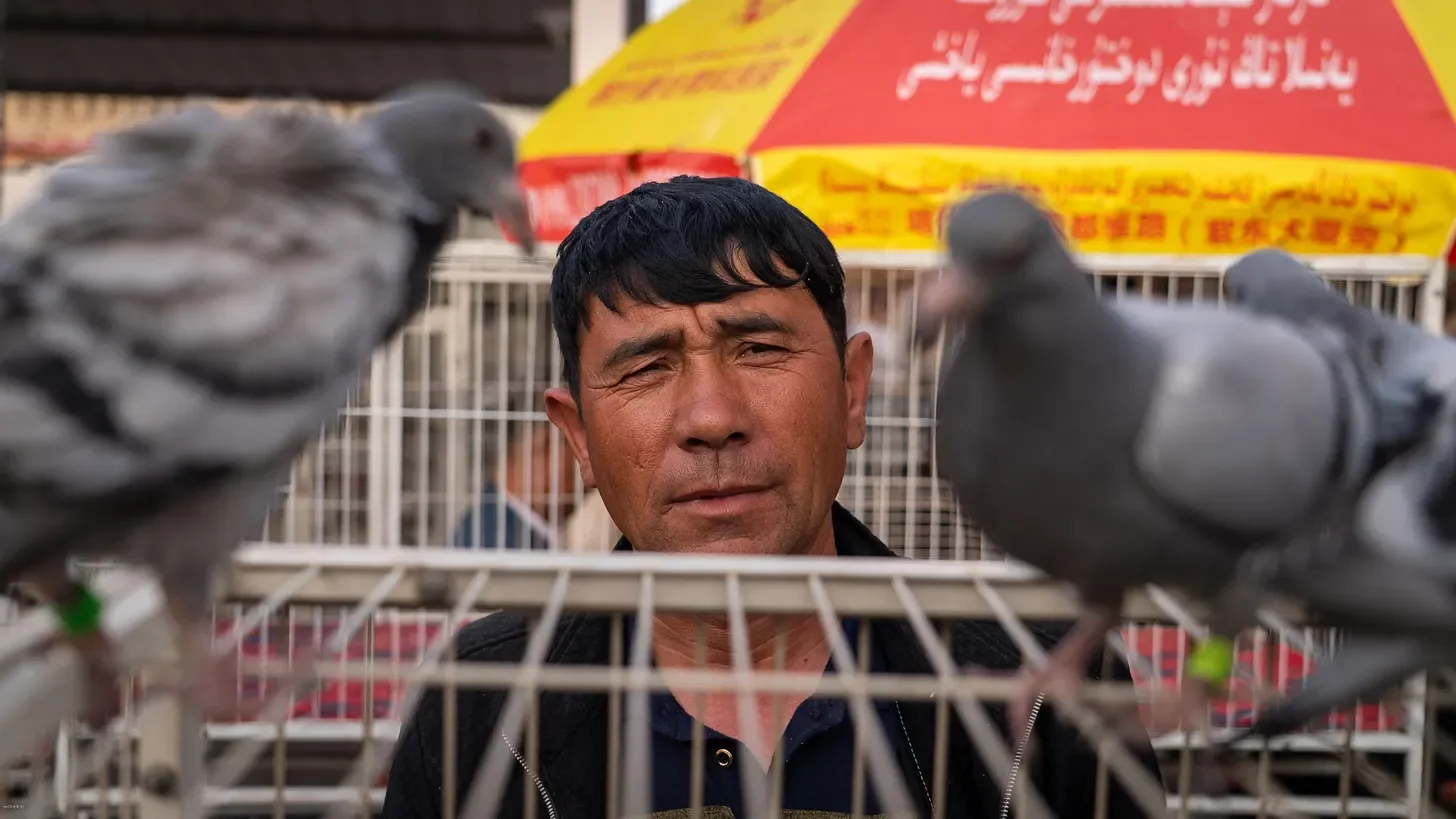
A pigeon seller inspects his racing birds at Kashgar’s pigeon market. Just like in horse racing, value is driven by bloodline, speed, and the bird’s homing prowess.
They take us up a rickety staircase to the rooftop where their uncle stands with a tall, quiet warmth. He greets us and gestures proudly toward large cages that line the rooftop. Inside, nearly 50 pigeons are housed, each bird with its own unique markings, their plumage a blend of cream, slate and copper.
With a knowing smile, the uncle opens the cages, and a flutter of wings fills the air. The pigeons erupt in a magnificent swirl, soaring upward in a graceful, synchronised dance. We watch, utterly captivated as the sky erupts in a flurry of wings and light.
As the birds glide higher, the uncle takes out a long, slender stick, and passes it to us with a chuckle. "You try it," he says with a wink, "it’s easy." His eyes twinkle with amusement, as if daring us to mimic the grace of his feathered companions. I hold the stick uncertainly, watching the birds take flight in perfect formation, their movements a blend of freedom and unity.
Pigeon racing, it turns out, is more than just a pastime. For many Uyghurs, it’s one of the few remaining spaces where tradition can survive unmonitored — a centuries-old sport that doubles as a subtle act of defiance. Some Uyghur artists and writers have even adopted the pigeon as a powerful metaphor — a symbol of quiet resistance, of a freedom longed for but never spoken aloud. It’s a small act of cultural continuity in a place where identity is constantly reshaped, regulated, and erased.
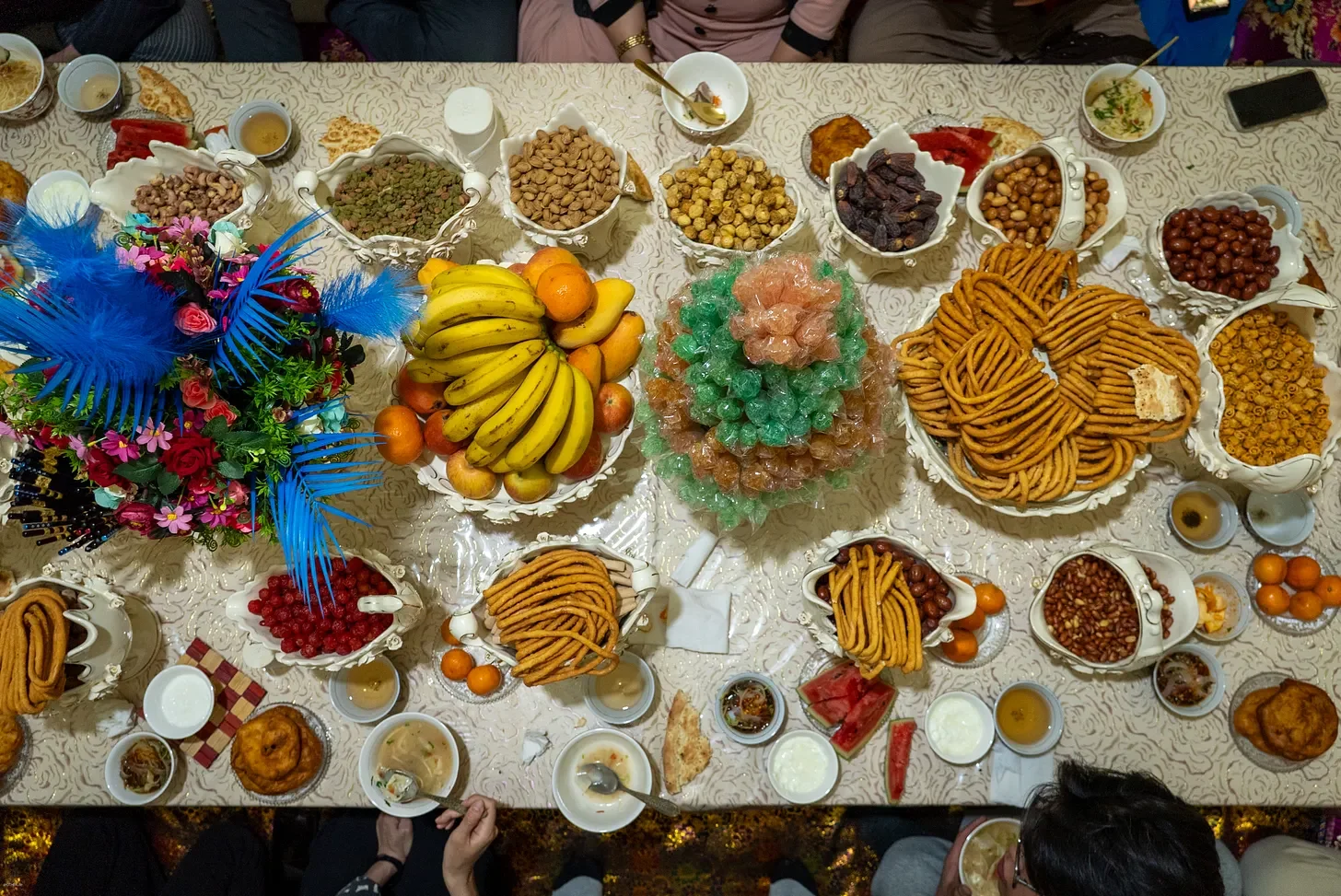
A welcoming spread of jewel-toned fruits, candied nuts, and sanzi — a traditional Uyghur fried dough twisted into golden threads. With over 2,000 years of history, sanzi symbolises continuity and legacy for the Uyghurs.
Moments later, the girls lead us downstairs to a brightly-lit dining room. A lavish spread of fruits, candies, and nuts fills the table, and their extended family is gathered, eagerly waiting. One by one, Uyghur specialties are served: Laghman, a signature hand-pulled noodle soup with tender beef; Manta, plump dumplings packed with savoury meat; and Polo, a traditional spiced rice dish featuring succulent, fall-off-the-bone lamb shank.
We left that night with full stomachs and fuller hearts. Despite sharp warnings from their local leaders, they had invited us into their home and treated us like family.
We were overwhelmed — by their kindness. Their warmth. Their defiance.
Islam with Chinese characteristics
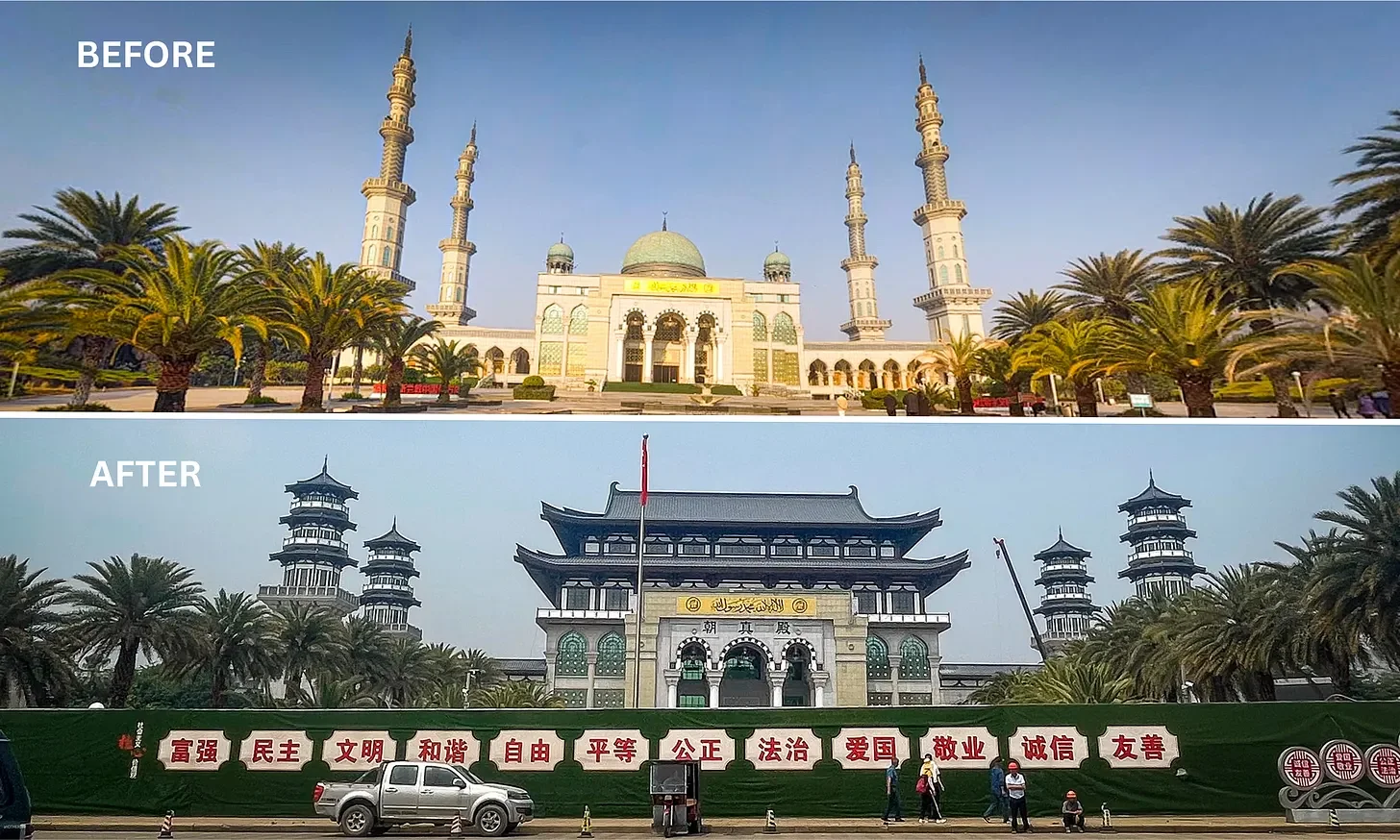
A before-and-after image of the Shadian mosque in Southwestern China, where Islamic domes and minarets were replaced in 2024 with a Han-style roof and pagoda towers. Critics describe the transformation as a “tragedy” and “desecration". Photo: Google Maps
In 2022, during a visit to Xinjiang, China’s President Xi Jinping declared that “Islam in China must be Chinese in orientation.”
To realise this vision, the government has taken sweeping steps: appointing Muslim leaders only after they pass Party “loyalty tests”; removing Islamic symbols such as crescent moons and stars from mosques; prohibiting fasting during Ramadan for certain groups and detaining vast numbers of Uyghurs in re-education camps known to perform psychological indoctrination and forced labour. These moves taken together, critics say, are a systemic campaign to erase Uyghur religious and cultural identity, replacing it with a state-sanctioned version of their religion that aligns with Party ideals.
We meet Aylin for tea the day before our flight out. She's barely twenty-five, poised yet soft-spoken, with luminous eyes that hold a quiet watchfulness — like they’ve learned when to speak and when to withhold. She was educated in Chinese government schools, has Han Chinese friends and is shaped by a different reality than her parents’. She now works for a Chinese company, and has learned to move comfortably between worlds. We think her perspective might carry a kind of balance.
We ask, gently, “What’s it like to live in Xinjiang as a Uyghur woman?”
She pauses, then shrugs lightly. “We’re always being watched,” she says in flawless Mandarin, the words landing without drama. Her gaze flickers to the street, then back to her cup.
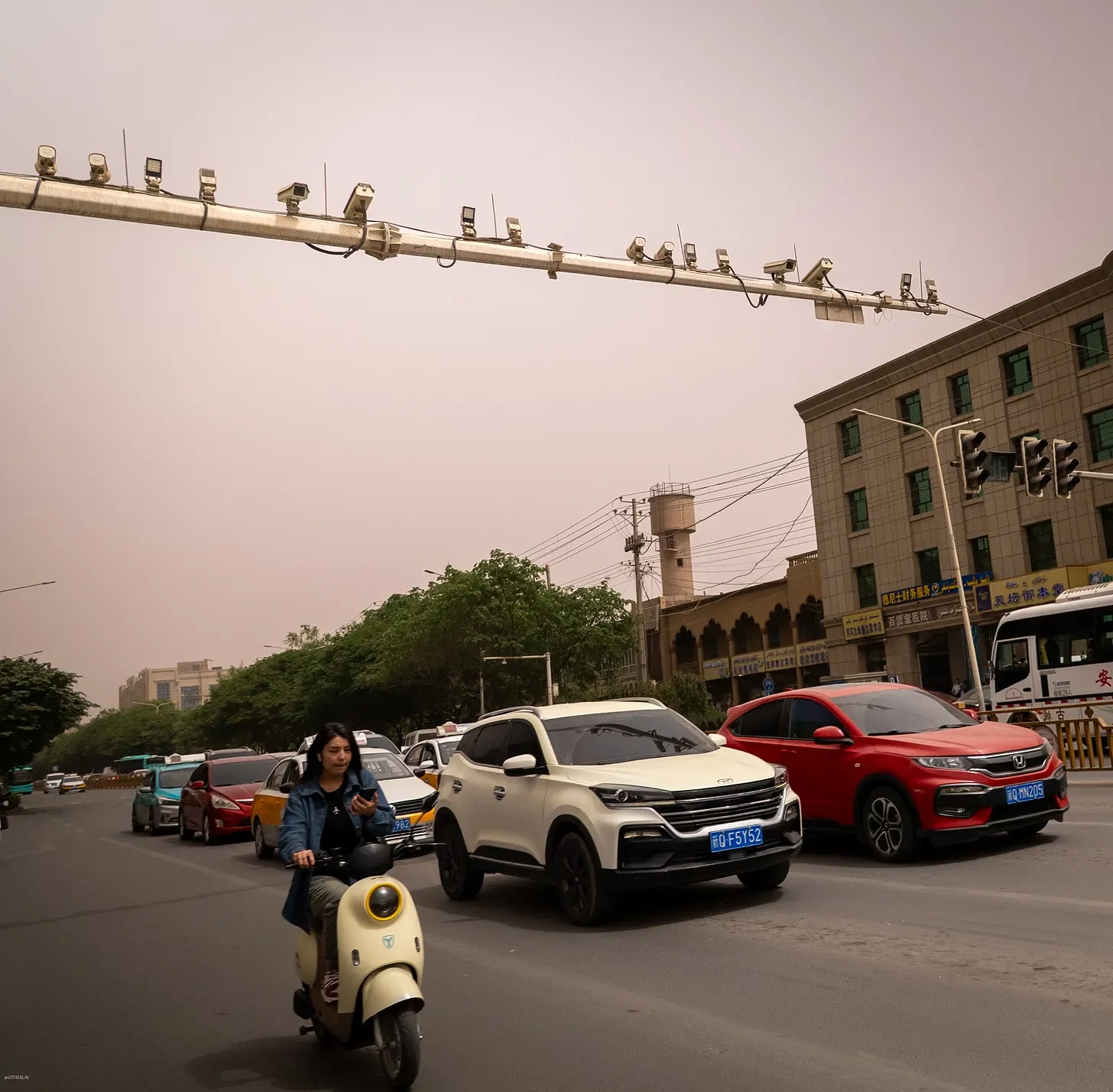
Almost 20 CCTV cameras mounted on a single pole in downtown Kashgar. In Xinjiang, even the street poles are part of the security detail.
“My family has to go to through a ‘cultural education’ session once a week, where we watch Chinese nationalist films,” she explains. “It’s not optional.”
She sips her tea, then adds with quiet resolve, “We don’t have much money, but we’re happy. We can work more if we need more — but we won’t push ourselves to chase it. Life is more than that.”
She pauses, her words ringing with wisdom. She knits her brows as though unsure whether to say more.
“We can’t learn Uyghur in school anymore,” she sighs with a gentle mourning. “That’s just… gone.” Then, almost reflexively, she adds: “But things are safer now… I think.”
She looks up at us, her expression composed but distant.
“We just try to live quietly,” she continues. “We keep our heads down. We don’t talk about politics. There’s no point. I just focus on my family, food and friends.”
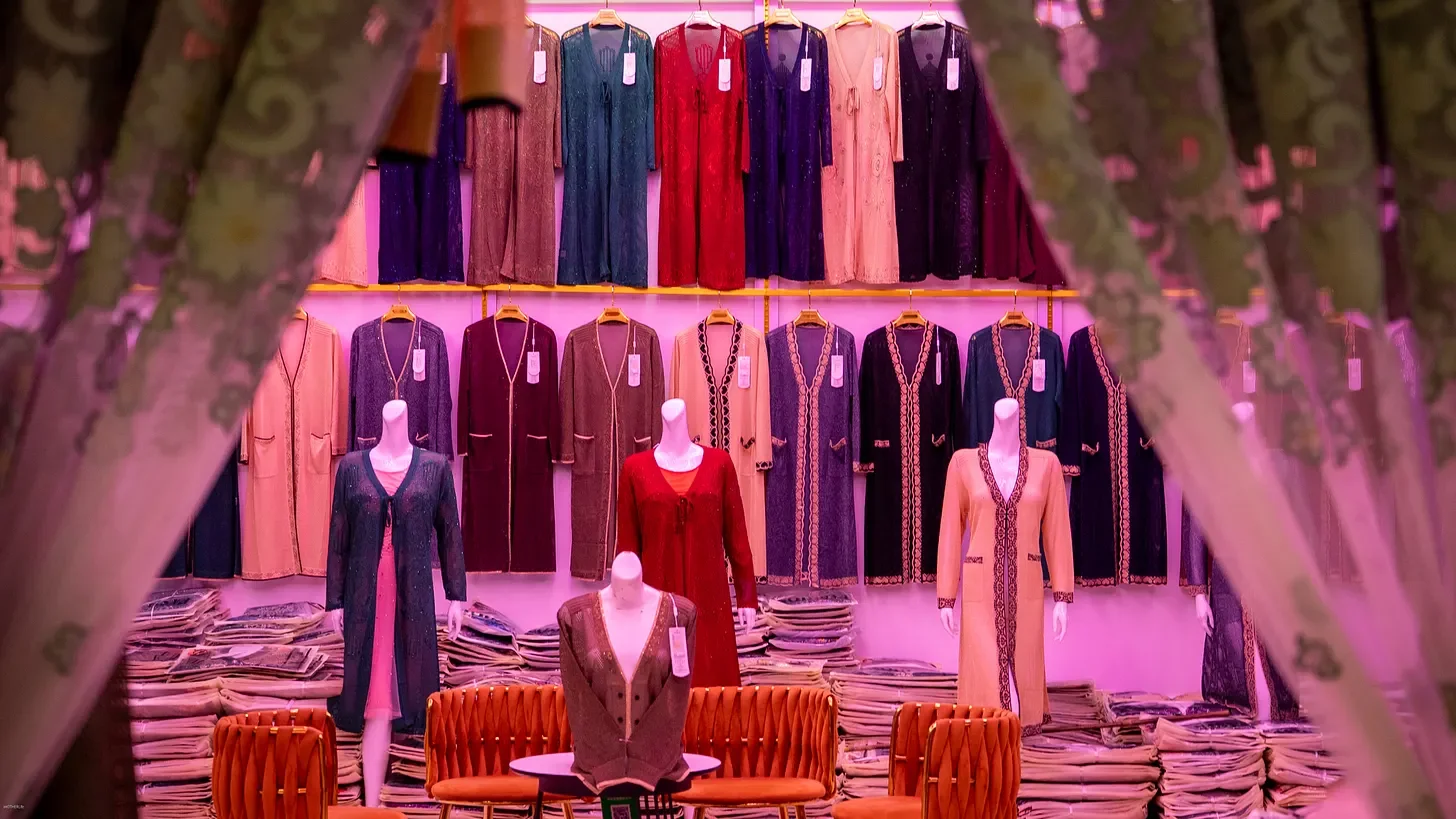
A mall in Kashgar selling traditional clothes tailored for modern tastes. Bathed in a magenta glow, the space takes on an oddly surreal atmosphere.
Halfway through tea, Aylin’s phone lights up. She glances down, then looks up, colour draining from her face. There’s a flicker of panic in her eyes.
“Sorry… something’s happened. I have to go. I’ll call you later.” she says, rising quickly from her chair.
We’re caught off guard. “Is everything okay?” we ask.
She hesitates, then answers in a low voice, “Our local Party committee just messaged, I have to take a Mandarin proficiency exam now. Our whole family needs to go.”
I blink, confused. “On such short notice?”
Her hands tremble slightly as she gathers her things. “I’m really worried about my mom,” she murmurs. “Her Mandarin isn’t good. If she fails… she’ll have to attend lessons every day for a year.” Her lips quiver, and for a moment she seems like a child again — frightened, helpless in the face of something vast and unyielding.
We try to reassure her, telling her we’ll wait for her to finish.
Three hours pass. The café empties, the sun dips low.
Then a message from Aylin arrives: “Let’s meet in the city centre.”
Faith, Silenced
The evening air is cool, tinged with sizzling smells of spiced lamb and offal. We thread our way through a night market glowing under strings of red lamps. Stalls brim with the surreal and the strange — roasted ostrich eggs, boiled sheep’s heads, offal skewers hissing over glowing embers. Aylin is waiting near a cart selling fermented camel’s milk.
“Want to try some?” she asks with a playful grin, a note of lightness returning to her voice.
We laugh, but the question weighs on us. “How’s your mom?” we ask.
Her smile falters. “I was really scared for her,” she says quietly. “Especially because… just last month she was detained by police.”
We stop walking, worried but trying to swallow our surprise.
“She was ‘gone’ for four days,” Aylin continues, eyes fixed on the ground. “No one knew where she was; we were not allowed to speak to her. When she finally came home, she was in shock. The police had taken her.”
“Why? What happened?” we ask, the words stumbling out.
Aylin’s eyes stay fixed on the ground. “One of my mom’s friends had been caught practising Islam… too much.”
The phrase lingers in the air like thick smoke. We try to clarify what ‘too much’ means, and she gives us a knowing look.
In Xinjiang, “too much” is a shifting line — invisible, arbitrary, and dangerous. Praying at the wrong time. Wearing a headscarf in the wrong place. Inviting a wrong person into your home. Sometimes much less.
“My mom was arrested,” Aylin says quietly. “They said she was guilty… just for knowing her friend.”
No fury rises in her voice — only the slow, dull ache of sadness worn down into quiet submission.
Li-Ann reaches out, placing a hand gently on her shoulder. “So… how do you and your family practise your faith now?”
Aylin doesn’t answer right away. Around us, the market hums — laughter echoing, music drifting, the warm scent of cumin and charcoal rising into the night.
Aylin answers, her voice weary, “We hide it in our hearts… it’s safer there.”
We don’t speak. There’s nothing left to say.
Li-Ann wraps her arm around Aylin, and we walk on through the glowing blur of the night market — faces smiling, vendors shouting, life moving on — as if everything were normal.
A Party billboard glows brightly in front of us. “This is our Chinese dream”.
This is the last of a 4-part series guest written by my partner S on our experience in China’s Far West, 15 years after riots first broke out in Urumqi.
Part 1: The Foreigner, The Chinese, The Uyghur
Part 2: The Foreign Tourist
Part 3: The Chinese Settler
